
The Pattern Repeats
Extract from the Scary Chronicles
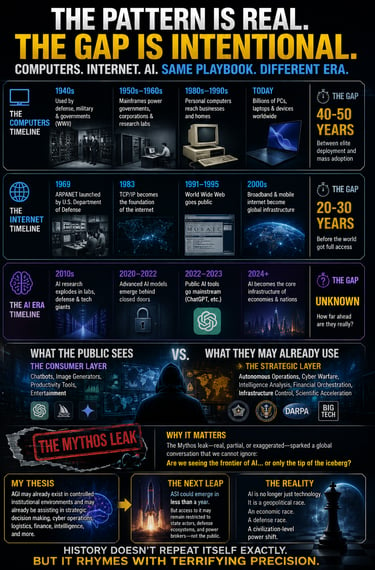
Computers → Internet → AI
History repeatedly shows us a clear pattern: The most advanced technologies appear first inside defense, intelligence, research, and elite corporate environments long before they become available to the public.
Computers
1940s: Advanced computers like ENIAC and Colossus were developed for military and intelligence purposes during World War II.
1950s–1960s: Mainframes powered governments, defense systems, scientific research, banks, and multinational corporations.
1980s–1990s: Personal computers finally became widely available to ordinary people.
That is roughly 40–50 years between strategic institutional deployment and true mass adoption.
Internet
1969: ARPANET was launched under the U.S. Department of Defense.
1983: TCP/IP became the foundation of the modern internet.
1991–1995: The World Wide Web reached the public.
2000s: Broadband and smartphones transformed the internet into global infrastructure.
Again, the most powerful networking systems existed long before the average person could access them.
Now Look at AI
Public AI exploded around 2022–2023 through generative AI platforms and consumer assistants.
But governments, intelligence agencies, defense contractors, and global corporations had already been investing heavily in advanced AI systems for years, if not decades.
The AI accessible to ordinary users today may only represent a carefully controlled public layer of a much deeper technological reality.
My position is straightforward:
The AI available to the general public today is very likely far behind the capability, orchestration, strategic integration, and sophistication of the systems already being utilized within defense, intelligence, and elite corporate sectors driving the global economy.
The same pattern happened with:
Computers
Internet
Cyber warfare
Satellite systems
Blockchain intelligence
Quantum research
Why would AI be any different?
The Mythos Leak
The so called “Mythos leak” intensified this debate by fueling speculation that highly advanced autonomous or near AGI level systems may already exist behind closed institutional environments.
Whether authentic, exaggerated, partially true, or psychological signaling, the importance of the Mythos discussion lies elsewhere:
It pushed people to seriously question whether the public is seeing the frontier of AI or merely the consumer layer beneath it.
That question alone is strategically important.
My Thesis
Many people still debate whether AGI is achievable.
My thesis is different:
AGI may already exist in controlled institutional ecosystems and could already be assisting in strategic decision making, cyber operations, logistics, financial orchestration, intelligence analysis, infrastructure optimization, predictive systems, and autonomous coordination.
And if the current acceleration continues:
ASI may emerge far sooner than most people expect, potentially within less than a year, but access to it may remain restricted to state actors, defense ecosystems, and major global power brokers rather than the general public.
AI Is No Longer Just Technology
AI has now become:
an economic race,
a geopolitical race,
a defense race,
an infrastructure race,
and ultimately a civilization level power shift.
The nations, institutions, and businesses that fail to build, integrate, and govern AI systems may face the same fate as those who ignored computers in the 1980s or the internet in the 1990s.
History never truly repeats itself exactly.
But it rhymes with terrifying precision.
-From the diary of Prof. Ahmad Bilal Khan, Founder and CEO of Kohenoor Technologies
#AI #AGI #ASI #ArtificialIntelligence #KAI #DefenseTech #FutureOfAI #MachineLearning #DeepLearning #AIRevolution #AIInfrastructure #CyberSecurity #DigitalTransformation #Geopolitics #Innovation #TechWar #Automation #AILeadership #AIResearch #Blockchain #HybridIntelligence #kohenoorai #KohenoorTechnologies #Education30 #FutureEconomy #Internet #Computers #MythosLeak #EmergingTechnology
© 2025 Kohenoor Technologies. All rights reserved.
Support: info@kohenoor.tech | Privacy Policy | Terms


Kohenoor Technologies is a global technology ecosystem building KENOS; the Operating System for the Intelligent Era. KENOS integrates Action AI, Hybrid Finance (HyFi), blockchain infrastructure, cybersecurity, enterprise intelligence and Education 3.0 within a unified operating environment.
The ecosystem is powered by KAI intelligent advisory, KENFI financial intelligence, KEN-HYFI hybrid financial rails, KENEX tokenization and digital-asset infrastructure, KEN Sentinel security intelligence, the KEN utility token and ProEdge professional education and certification.
Kohenoor Technologies enables enterprises, institutions and individuals to adopt intelligent technologies, modernize financial and digital infrastructure, strengthen security and develop future-ready skills for an increasingly AI-driven global economy.