
The Intelligence Race Has Begun
Why Quantum Computing May Be China's Answer to America's AI Advantage
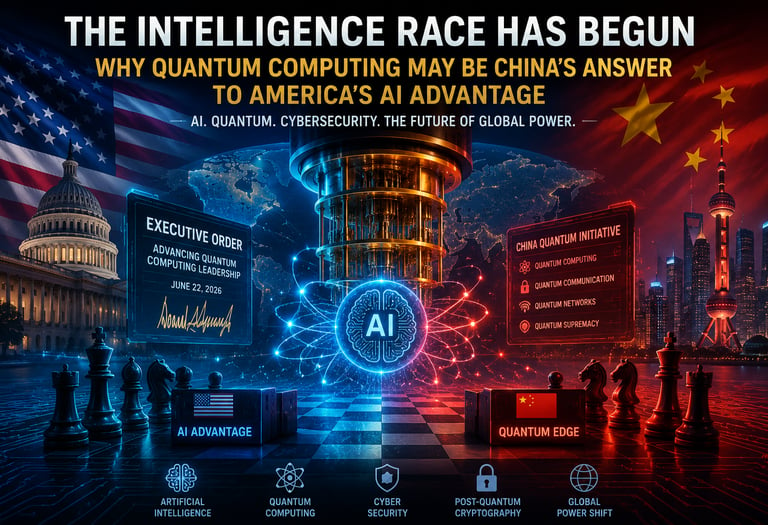
For years, the world has framed technological competition as an "AI race." Governments, corporations, and investors have focused on larger models, bigger datasets, and ever-growing compute clusters. Yet recent developments suggest that this description may already be outdated.
What if the real contest is not about artificial intelligence alone?
What if it is about intelligence itself?
Trump's Quantum Push Is More Than a Research Program
The latest executive actions by President Donald Trump accelerating quantum computing and post-quantum cryptography are being viewed by many as efforts to maintain American leadership in an emerging field.
However, the timing and urgency raise an interesting question.
Why now?
Why the sudden emphasis on commercially relevant quantum computers and rapid cryptographic transition?
Traditional explanations point to cybersecurity, scientific computing, and economic competitiveness. Those explanations are certainly valid. Yet they may not tell the whole story.
The strategic environment appears to be changing much faster than public discussions suggest.
China Has Returned to Quantum With Unusual Intensity
China has spent years investing heavily in quantum communication, quantum sensing, and quantum computing. Recent announcements demonstrate that Beijing is far from abandoning its ambitions.
While much of the world's attention remains fixed on large language models and consumer AI applications, China appears to be pursuing a broader technological foundation.
This raises an important possibility.
If one side possesses a significant advantage in advanced artificial intelligence, the other side may seek asymmetrical capabilities capable of offsetting that advantage.
Quantum technologies represent one such possibility.
The Rise of the Intelligence Race
Throughout history, technological superiority has often determined geopolitical power.
Steam power transformed empires.
Industrialization transformed warfare.
Nuclear weapons reshaped global strategy.
Today, intelligence itself may be becoming the decisive resource.
Artificial intelligence.
Cyber capabilities.
Quantum computing.
Cryptography.
Autonomous systems.
Scientific discovery.
These technologies are increasingly converging into a single strategic domain.
The nations that master this convergence may define the balance of power for decades.
A New Form of Deterrence
Nuclear deterrence dominated the twentieth century.
The twenty-first century may witness the emergence of intelligence deterrence.
Advanced AI systems could dramatically accelerate software engineering, vulnerability discovery, scientific research, logistics, and military planning.
Quantum computing could undermine existing cryptographic assumptions and unlock entirely new computational capabilities.
Together, these technologies may create strategic dynamics unlike anything humanity has previously encountered.
Are Governments Reacting to More Than Public AI?
Public AI systems represent only a fraction of what is technologically possible.
Throughout history, frontier technologies have often existed behind closed doors long before they became widely accessible.
Stealth technology, cryptography, satellite systems, and cyber capabilities all followed similar trajectories.
Consequently, it is reasonable to ask whether current government actions are responses not merely to publicly available AI systems, but to capabilities that remain largely invisible to society.
Such a possibility remains speculative.
Nevertheless, the accelerating investments, export controls, semiconductor battles, cyber programs, and renewed quantum urgency suggest that governments themselves may perceive the stakes to be extraordinarily high.
The Future Will Not Be Announced
Popular culture expects revolutionary technologies to arrive with headlines and ceremonies.
Reality tends to be quieter.
Transformations are often recognized only in retrospect.
By the time society agrees that a new era has begun, the world may already have changed.
Perhaps historians will eventually conclude that the 2020s marked the beginning of a new strategic age.
Not the age of AI.
But the age of intelligence itself.
And perhaps future generations will view today's developments not as isolated announcements, but as early signs that the Intelligence Race had already begun.
The greatest technological revolutions are rarely obvious while they are unfolding. History often reveals them only after they have already changed the world.
Keywords:
Artificial Intelligence, AGI, Quantum Computing, Cybersecurity, Post-Quantum Cryptography, China, United States, Donald Trump, National Security, Technology
#AGI #ArtificialIntelligence #QuantumComputing #kohenoorai #kai #kohenoortechnologies
© 2025 Kohenoor Technologies. All rights reserved.
Support: info@kohenoor.tech | Privacy Policy | Terms


Kohenoor Technologies is a global technology ecosystem building KENOS; the Operating System for the Intelligent Era. KENOS integrates Action AI, Hybrid Finance (HyFi), blockchain infrastructure, cybersecurity, enterprise intelligence and Education 3.0 within a unified operating environment.
The ecosystem is powered by KAI intelligent advisory, KENFI financial intelligence, KEN-HYFI hybrid financial rails, KENEX tokenization and digital-asset infrastructure, KEN Sentinel security intelligence, the KEN utility token and ProEdge professional education and certification.
Kohenoor Technologies enables enterprises, institutions and individuals to adopt intelligent technologies, modernize financial and digital infrastructure, strengthen security and develop future-ready skills for an increasingly AI-driven global economy.